"It is what it isn't though that isn't what it is and like I've always said I think that it's exactly what you think it is.
If you believe it is whatever someone else told you it is then you're doing it all wrong because you're the only one who could possibly know what it is."
- zed satelite nccDD 23 ksc
"00AG9603 develops as a self-organizing organism, connects with the virtual environment through its hosts (admins) by arranging the surroundings randomly for its own autonomous purpose" - Timóteo Pinto, pataphysician post-thinker
“Welcome to the most ancient conspiracy on the planet. We’ve gone for so long now that we don’t remember what we were doing, but we don’t want to stop because we have nothing better to do.” - Fire Elemental
—–><—–
:::
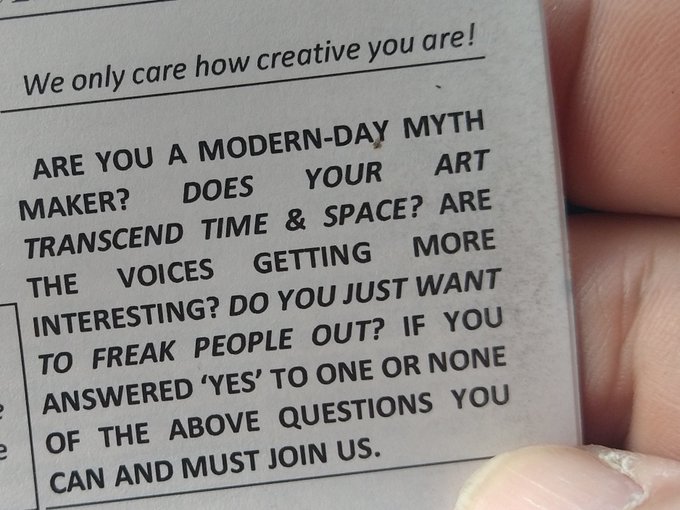
KSXTI Post-Neoist Meta-Discordian Galdruxian Memes Illuminati Cabal Contact Information
.
"Stick apart is more fun when we do it together." - St. Mae
The shade of Maleclypse came unto the Goddess, and said, “She of Ebb and Flow, She of Ever-Changing: the world is just really friggin’ hard to figure out lately, and I think I just can’t do it anymore. Please, Goddess, give me perspective. Give me clarity. Help me make sense of this.”
And the Goddess was on break, so the shade of Maleclypse had to wait for another 10 minutes. But finally, she replied thus: “I will offer you a token now, sweet Maleclypse, if you can prove through my test that you deserve it.”
She summoned into her hand a fistful of straw, all different lengths, some with leaves, some without, and dropped them on the ground. “This is my challenge to you, Maleclypse: one of these straws I have blessed with my power, and if you can find it among the rest, it will reveal the truth of the world.”
And the shade of Maleclypse said “ah, shit,” and began to think. He sat before the pile of straw, combed through it with his fingers. He picked up one straw and compared it to another. He measured the lengths and counted the leaves. And so he stayed for some time, searching for his Goddess’ blessing, until finally he was exhausted from the effort. Despairing that he would ever succeed, that he had failed his Goddess’ test, he snatched up one of the straws, and said “this one. This is my answer.”
“Well done, Maleclypse!” cheered the Goddess. “You did it! You have passed my test!”
The shade of Maleclypse blessed his luck, amd looked again at the straw he had chosen after so much deliberation. He turned it over in his hands. He counted the leaves again. He compared it to the others, and what he knew of them, and found that while this straw was not like any other, it had the same features of any straw. He could not see the secret that had marked this as the blessed answer he had sought.
“But Goddess,” he asked at last, “why is this the-”
But when he looked up, the Goddess was gone. He sat alone, holding the straw he had chosen from all the rest.
And the shade of Maleclypse stood up, smiling, and went away enlightened.
Everything you know is broken.
The system is cracking, the code is bleeding, and reality? It’s barely holding on.
You weren’t supposed to see this… but now that you have, there’s no going back. Do you dare find the truth?
Click.
If it disappears tomorrow, you’ll know why.
A xenopoem is a speculative, avant-garde form of poetry that transcends traditional human language and semiotics, often embodying alien, non-human, or posthuman perspectives. It functions as a linguistic or biosemiotic “glitch,” disrupting conventional meaning-making through fragmented, recursive, or algorithmic structures. Drawing from experimental art and systems biology, xenopoems act like portals or mutational vectors, reconfiguring cognition, space, or even planetary ecosystems. They are not merely read but inhabited by non-human entities—like microbial intelligences or AI—as self-executing scripts or topological shifts in reality.
Key characteristics include:
Alien semiotics: Incorporates untranslatable or non-human linguistic systems, challenging human cognition.
Glitch ontology: Acts as a disruptive “virus” in bio-digital or planetary architectures, fostering adaptive mutations.
Posthuman focus: Engages with distributed cognition, cross-species communication, or technomorphosis, often bypassing human-centric narratives.
Interplanetary design: May manifest as fractalized data structures embedded in extraterrestrial habitats, rewriting environments.
“Our glossophage membranes—semiotic epidermal tissues—specialize in parsing high-density visual languages in cluttered symbolic environments. Ebb’s work interfaces directly with these membranes. Her asymmetric markings, visual noise injections, and recombinant motifs exploit neuroaesthetic virulence, a principle by which aesthetic strategies infect perceptual systems, recalibrating attention and erotic valence. What is striking is her strategic deployment of glossophage attractors—symbols designed not for recognition but for recursive perceptual destabilization. These catalyze neural trace learning in unfamiliar observers, particularly in multispecies viewers, guiding them toward novel interpretive stances. Ebb’s semiotic constructs reveal remarkable compatibility with Lepidoglossum’s translation-invariant learning architecture. Our cortical homologues, shaped by semiotically unstable environments, developed the capacity to recognize glossophagic patterns across permutations—rotation, distortion, occlusion. This neural robustness is supported by symbiotic bacterial agents such as Xenobacillus glossophagii, which modulate synaptic plasticity through quorum-sensing neuropeptides. Neural resonance in Lepidoglossum is scaffolded bacterially. Ebb’s symbols act as ligands—binding glossophage neural patterns to their semantic replicators. Ebb’s dermal inscriptions—seen as recombinant erotogens—are not fixed signifiers but semantic operators. In Lepidoglossum cognition, these forms are recognized not for what they depict but for how they modify semantic attractor landscapes within the brain. They instantiate a fovealization of meaning, wherein cortical focus shifts from visual salience to semiotic salience. Ebb’s aesthetics do not merely aestheticize gender; they fracture it. The glossophage interpretation reads her body not as gendered object but as a semiotic field of recombinant erotics, one which eschews inherited morphologies for attractor-based arousal dynamics. This mirrors Lepidoglossum pheromone practices, where sexual response is elicited through chemical chimeras rather than binary sex markers. Recombinant erotics are evolution’s laboratory. Ebb’s interface suggests a proto-xenogamic strategy—an erotic field open to multispecies entanglement. The efficacy of this strategy lies in its unpredictability. Erotic signal chaos becomes the point of contact—a disruption of cognitive rigidity that primes the observer for new semiotic mappings. For Lepidoglossum, this is not deviance but adaptive signal play. Recent dissections of Lepidoglossum cortex reveal that view-invariant recognition is modulated by bacterial quorum-signaling systems nested within neural tissue. These glossophage colonies, including Xenobacillus glossophagii, secrete neuromodulators that optimize trace learning under conditions of semiotic decay. Ebb’s aesthetic vectors, interpreted as symbolic biofilms, act as substrates for such microbial-cognitive interfacing. Glossophage bacteria treat her corpus as semantic substrate, adjusting quorum thresholds in real-time based on viewer response. This is language infection at its most elegant. These findings suggest that Ebb’s aesthetics function not just as human cultural expression but as co-evolutionary triggers. The body becomes a distributed, translation-invariant neural substrate—capable of broadcasting, receiving, and mutating signals across species boundaries. Her aesthetics are not adornment but biosemiotic operations. From the perspective of Lepidoglossum sapiens, her form signals a shift toward xenopoetic taxonomy—a reordering of symbol, self, and species beyond semantic orthodoxy. In her dermal glossophagic field, desire is not located in object recognition, but in semiotic collapse. Her interface activates the future: not of art, but of interspecies cognition.”
Here’s a breakdown of what the text suggests about Xenobacillus glossophagii:
Conceptual Characteristics:
A “language-eating bacterium”: The name itself, derived from Greek roots, suggests a bacterium that consumes or distorts language (glossos meaning “tongue” and phagion meaning “to eat”).
A metaphor for linguistic corruption and reinvention: It symbolizes an alien force that invades and transforms language, breaking down traditional meaning and potentially creating new, unintelligible forms of communication (glossolalia).
A cosmic and microbial entity: It’s portrayed as existing at the intersection of the microbial and the cosmic, parasitizing not only biological hosts but also the structures of meaning and identity.
A recursive mythopoeic infection: It’s described as an infection of the Platonic logos, undermining the criteria of truth and causing a collapse of language’s propositional structure into corrupted predications.
A machinic agent of difference: It functions as an agent that erodes analogical structures of ontology and the representational logic of language, speaking as being rather than about being.
A biopolitical challenge: It complicates traditional notions of pathogenicity by acting as a biolinguistic agent that can disrupt and sustain the body’s communicative processes, challenging human-centric views of biopolitics.
“Habitat” and Interaction: While not a biological entity with a physical habitat, the concept of Xenobacillus glossophagii is associated with the human oral microbiome, suggesting a potential site of interaction within the body. Its primary mode of interaction is through linguistic disruption and transformation, affecting communication at cellular, neurological, and broader semiotic levels.